Where does Gardening Fit In?
When I started homeschooling over 16 years ago, I knew that my children would be learning how to read, how to write, how to do mathematics, science, geography, and history. One thing I did not expect or even think about teaching them was the survival skill of gardening.
Then 10 years ago, my oldest son, who was 10 at the time, asked to grow a veggie backyard garden. I knew nothing about gardening. I didn’t have a clue how to start or even understand how this activity could fit in our homeschooling day.
My life was already full. I was surviving the dishes, the laundry, the meals, the schooltime, and a crazy life with three diverse and amazing kids. Adding one more thing to my plate felt too overwhelming. But we decided to start a garden. And I’m so thankful that we did.
From that small garden, our little family learned so many important life skills that also helped their learning processing. In this article you will discover how to boost and enhance learning for your K-3 child through gardening experiences.
Read Part I of this 3 part Series: 5 Easy Ways to Introduce Gardening to your Early Learner
Read Part 3 of this 3-part series: Dirty Jobs: It’s Not What You Think!
Listen to the Podcast as Alicia shares how she went from Black to Green Thumb!

Improve Thinking Skills Through Hands-On Learning by Gardening
As technology becomes more evasive in our kids’ everyday lives, it’s easy to forget the value of outside learning and hands-on experiences.
Recent studies have shown that getting kids involved in activities like gardening can actually boost brain development and social engagement. When children participate in hands-on learning experiences, they are able to better connect with and remember the information they are learning.
Taking your science outside each week during your homeschooling day, to grow a garden gives your family time to process and watch things change slowly. In this world of quick responses, our kids need the space to slow down and just relax. In a garden, that space is there just for them.

Science Exploration for Young Learners!
Have a kiddo who can’t get enough of hands on leanring? Our Science Exploration A and Science Exploration B classes are just what you are looking for! Weekly experiments that challenge, inspire and delight!
Topics include Biology, Marine Biology, Zoology, Botany, Human Anatomy, Physiology. No textbook needed!
Connecting School Learning with Real Life
It’s more important than ever to engage your kids in meaningful, practical experiences with their “normal” homeschooling studies like reading, science, and mathematics.
Gardening provides an excellent opportunity to do just that. By getting their hands dirty and digging into the world of plants and growing food, your kids are able to see how math, science, and language arts all come together in tangible, hands-on ways.
Whether they are measuring the pH levels of soil or writing descriptive essays about the plants they see growing, students are able to truly understand how these academic subjects relate to the real world. Gardening is a great way to enhance learning and help students connect their everyday studies to their everyday experiences.
Creating Bonding Experiences Naturally by Gardening
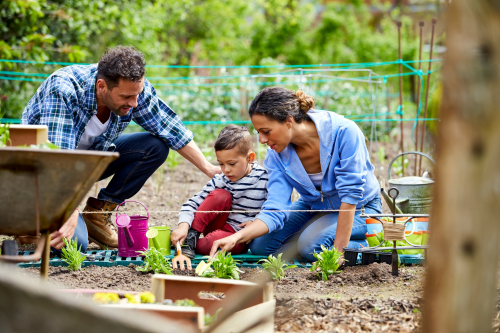
There are so many benefits of working together on a family garden project. Not only does it create a beautiful space filled with fresh veggies and flowers, but it also provides quality family time.
With everyone pitching in and contributing to the project, kids learn important skills such as teamwork, communication, and problem-solving.
By encountering obstacles together, they learn to work through disagreements and develop a sense of camaraderie that can carry over into other areas of life. In addition to the practical benefits, there is also something incredibly rewarding about watching something grow and thrive as a family.
When I think back to those homeschooling days that all three of my kids were outside planting, observing, processing, and talking together, I just smile at the memories that will be with our family forever.
Learning to Eat What You Grow
As parents, we all want our children to eat healthy and understand the importance of nourishing their bodies. But in our modern world of fast food and convenience, it can be easy to lose sight of where our food actually comes from.
That’s why it’s so important to teach kids about the cycle of food and help them understand the source of their meals. When we take the time to show our children how fruits and vegetables grow and how food gets from the garden to the table, we help them develop an appreciation for nature and the hard work that goes into producing the meals we enjoy.
Plus, when kids understand where their food comes from, they’re more likely to make healthy choices and value the importance of good nutrition throughout their lives.
I purposefully plant snap peas next to our house every fall and spring. As my youngest with autism and I leave or come into the house from the backyard, we both automatically grab snap peas and start munching. Somedays, that is the only green veggie I’m able to get him to eat. But he will eat those organic greens because he helped me plant those seeds. He helped me grow them.
Build Self-Confidence by Gardening
Gardening is an ideal way to help kids build their self-confidence. Not only does it provide a sense of achievement, but it also offers opportunities for self-control, decision-making, and problem-solving.
In particular, gardening can teach kids the importance of problem-solving. When plants aren’t growing as they should be, kids can learn to troubleshoot the problem and try different solutions until they find success.
This process enables them to become more confident in their abilities and equips them with the skills they need to overcome challenges in other areas of their lives. Furthermore, gardening provides a serene environment for children to engage in self-reflection and processing time, leading to a more confident and assured future.
My oldest son, who started this garden experience for our family, would often be seen in our first garden outside away from the noise or the expectations of being in the house. The garden gave him a space to use his senses, to calm down, and to enjoy just being.
That little garden became more than just a life skill. It became a way of life, break from the normal activities of survival. A space where each of my little family could grow as people as they watched their garden grow.
I want to encourage you to start a small garden, whether it is a few containers, a vertical planter, or a raised bed. Start a space to grow some food. Use the garden as a learning experience that I know will become invaluable to your kids and you. Start giving your kids this amazing experience of growing a garden together.

Grab your FREEBIE Printable!
From Seed to Sweet- how to grow a watermelon in a pot!
Tips to Start a Container Garden with Your Kids:
Check out this list of tips on growing your first garden in containers.
- Choose the right containers: Select containers that are big enough to hold soil and plants, but small enough for your kids to handle. Look for pots with drainage holes to avoid overwatering.
- Pick easy-to-grow plants: Start with easy-to-grow plants like herbs, cherry tomatoes, and lettuce that grow well in containers and don’t require a lot of maintenance. You can also consider starting with seedlings instead of seeds to make the process easier.
- Prep the soil: Fill the containers with organic raised bed mix, which is specially formulated for container gardening. You can also add organic compost to provide extra nutrients for your plants.
- Get planting: Have your kids help with planting the seeds or seedlings in the containers. Do not follow the seed packets for spacing. Plant closer than recommended in an intensive style of growing.
- Water and care for your plants: Set a schedule for watering and caring for your plants. Have your kids help with tasks like watering, pruning, and harvesting. This will teach them responsibility and give them a sense of ownership over the garden.
- Enjoy the fruits (and veggies): Once your plants start to grow and produce, enjoy the fruits (and veggies) of your hard work! Use them in recipes or simply enjoy them fresh from the garden.
Starting a backyard container garden with your kids can be a great way to bond, learn, and have fun together. With a little planning and effort, you can create a beautiful and productive garden that your whole family can enjoy.

Botany
Join fellow True North Homecshool Academy students this year for an exciting, unique look at the world of plants! Content will include plant anatomy, appreciating herbs & medicinal plants, foraging, gardening & more! Students will learn how to keep a science notebook, as well as participate in labs. This class is suited for junior high students (6th-8thth grade) can be used as a high school elective !
Alicia has been homeschooling for the past 16 years and is a mom of 3 kids. She has a master’s degree in education and has become a certified Gardenary Garden designer and coach. With her kids as her inspiration, gardening has become an essential part of their homeschooling day. She wants to help other homeschooling families create spaces to grow, learn, and breathe. Follow her to learn more about gardening. You can find her gardening and teaching over at Create My Garden.